

Meet Cultured Meat: The Basics
Why do we Need alternatives to conventional meat?
As global demand for meat, dairy, and eggs has steadily increased over the past decades, so has the environmental footprint of livestock farming. A major impact relates to greenhouse gas (GHG) emissions, primarily methane produced by cattle and sheep during digestion in the rumen. In addition, depending on storage conditions and treatment systems, manure releases methane as well as nitrous oxide (N₂O). Nitrous oxide is also produced through fertilizer use for feed crops and through manure applied to soils. Moreover, carbon dioxide (CO₂) emissions from land-use change—such as deforestation and the conversion of carbon-rich ecosystems—also play an important role. Forests store carbon in the vegetation and the soil, when they are cleared for pasture or feed crop production however, part of this carbon is released while, at the same time, the planet’s capacity to absorb CO₂ is reduced.
Deforestation linked to agricultural commodities is also a major driver of forest loss. Cattle pasture expansion and soy cultivation for animal feed are both frequently implicated in tropical deforestation. Notably, comparative studies of food systems have shown that ruminant meat—especially beef—has the highest land-use footprint per unit of protein.
Livestock farming also affects water resources and biodiversity. The IPBES Global Assessment identified land-use change as a major driver of biodiversity decline. Water is used directly for animals and farm operations, but much of the footprint results from irrigation for feed crops. In addition, manure and nutrient runoff can degrade water quality.
These impacts are expected to grow, placing increasing pressure on ecosystems and natural resources; meeting the world’s rising demand for food therefore requires efficient and sustainable ways to produce meat. To address this challenge, a range of alternative approaches has emerged. These include improvements in conventional livestock management—such as better feeds, improved manure management, and improved grazing practices—as well as dietary shifts toward plant-rich diets, the development of plant-based meat analogues, and, increasingly, cultured meat.
Among these solutions, cultured meat has attracted growing attention as an innovative approach that could produce meat without raising and slaughtering animals, potentially reducing the environmental pressures associated with conventional livestock farming.
What is cultured meat and how is it produced?
Cultured meat is part of a new industry known as cellular agriculture, a term used to describe biotechnological approaches aimed at producing animal-derived products—mainly meat, milk, and leather. Cultured meat is produced by cultivating animal cells in controlled laboratory conditions rather than raising and slaughtering animals.
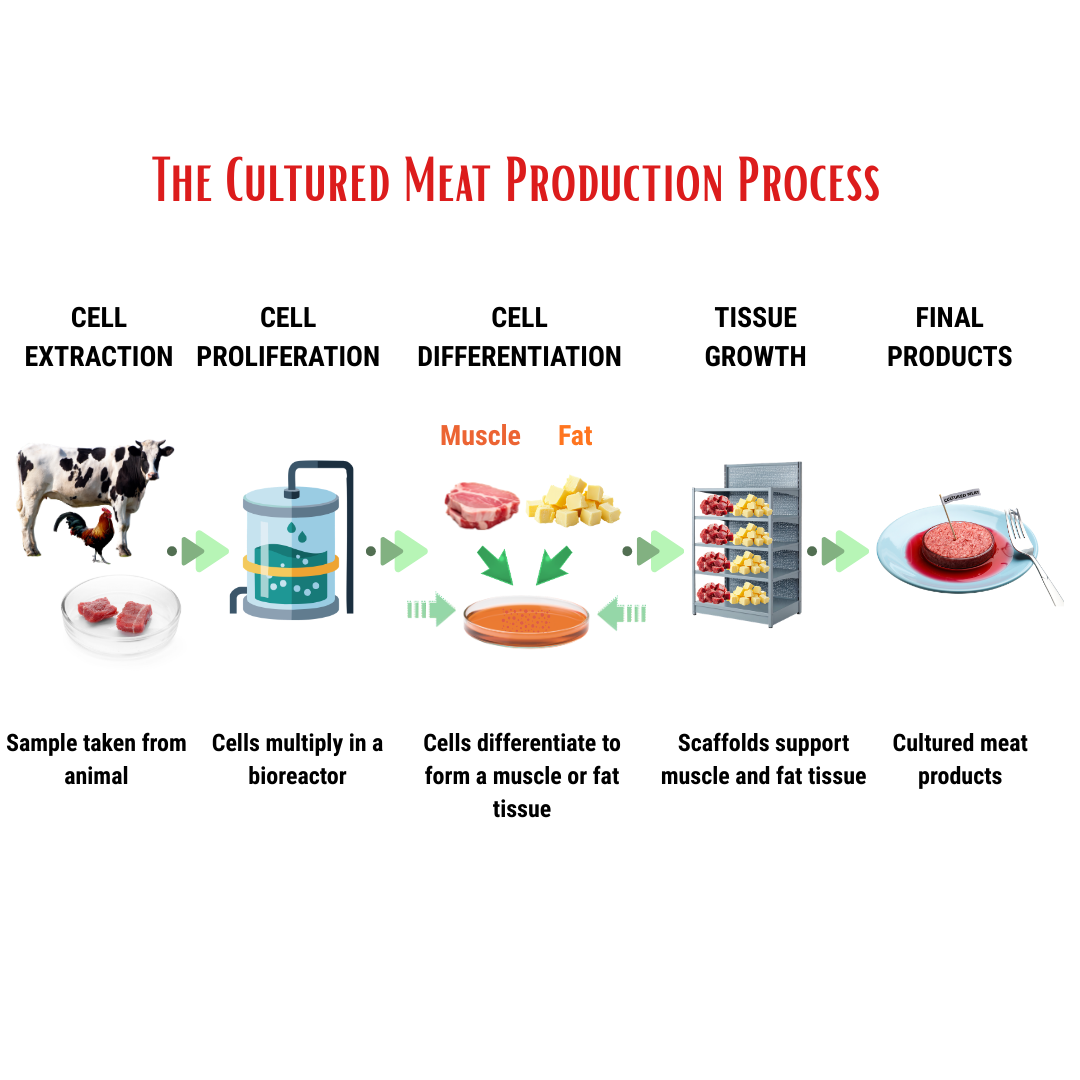
The production of cultured meat (see Figure) begins with the extraction of muscle or stem cells from a living animal through a biopsy. These cells are then expanded in a nutrient-rich culture medium containing amino acids, vitamins, and growth factors that support cell proliferation. Once sufficient cell mass is obtained, the cells are induced to differentiate under carefully controlled conditions that mimic those found in the animal body. To achieve tissue structures similar to conventional meat, the cells grow on three-dimensional scaffolds that support tissue organization. After maturation, the resulting tissue can be processed into products such as ground meat, nuggets, or potentially whole-cut meats.
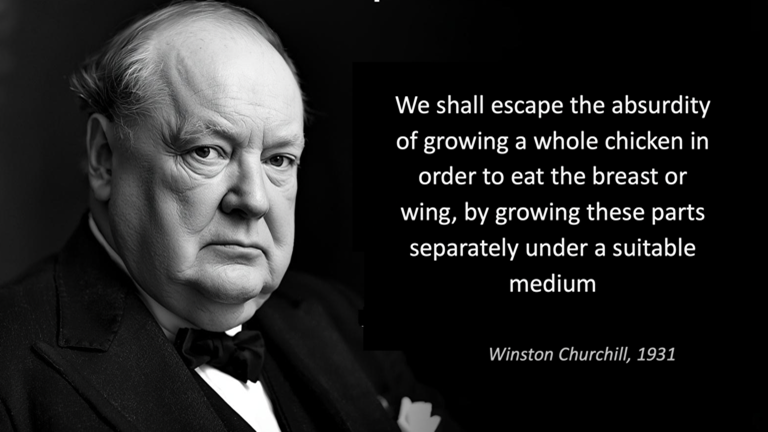
The concept of cultured meat was first described by Winston Churchill in an article for Strand Magazine titled “Fifty Years Hence” in 1931. In it, he speculated about future scientific developments and wrote, among other things: “With a greater knowledge of what are called hormones, i.e. the chemical messengers in our blood, it will be possible to control growth. We shall escape the absurdity of growing a whole chicken in order to eat the breast or wing, by growing these parts separately under a suitable medium.” Although we do not know exactly what Churchill had in mind, this is one of the earliest references to the idea that slaughtering animals could be replaced by the in vitro production of meat.
However, practical development began much later. The first cultured beef burger was publicly presented in 2013, demonstrating that it was technically possible to produce meat from animal cells in the laboratory. Since then, rapid progress has been made through the emergence of biotechnology startups, improvements in cell culture media, scaffold materials, and bioreactor technologies, as well as increasing investment from the food industry. By the early 2020s, several countries had begun evaluating regulatory frameworks, and some cultured meat products received approval for commercial sale—an important step toward the potential large-scale adoption of cell-based meat production.
From Laboratory Innovation to Market Reality
Despite its promise, several technological and economic challenges still limit the large-scale commercialization of cultured meat. These include the development of cell lines with improved stability and productivity, optimization of cell culture conditions—particularly the creation of cost-effective defined media—as well as reliable differentiation protocols to generate the different cell types required for meat tissue. Additional challenges include scaling up bioreactors and designing scaffolds capable of replicating the texture and structure of conventional meat.
Nutritional aspects also require further refinement, as current prototypes sometimes exhibit lower protein concentrations or altered lipid profiles compared with traditional mat products. Continued research is therefore needed to improve both the nutritional quality and the sensory attributes of cultured meat.
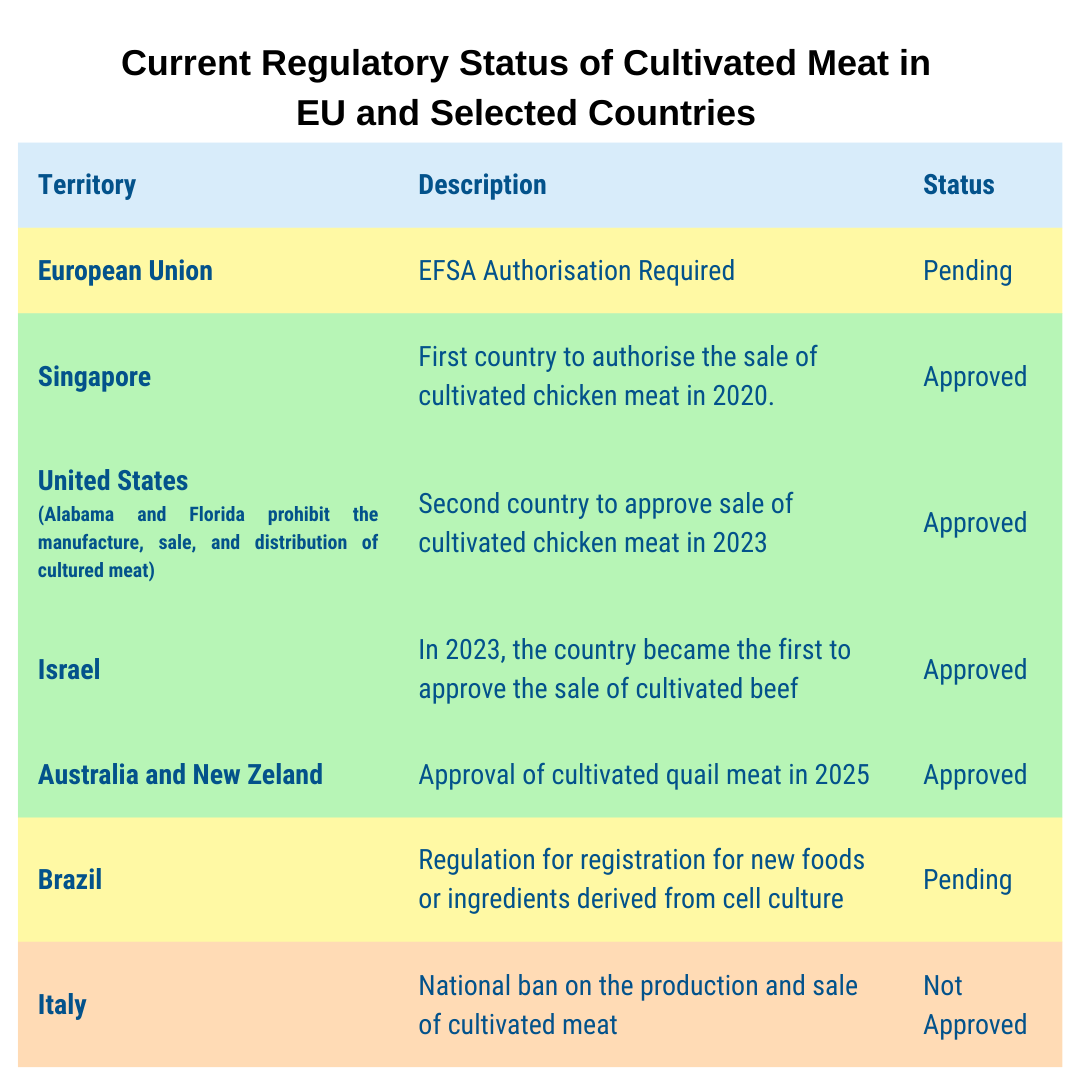
Regulatory frameworks and consumer acceptance will also play a critical role in determining the future of cultured meat. While countries such as Singapore, the United States, and Israel have already approved certain cultured meat products for commercial sale, regulatory approaches remain inconsistent across the globe. Public perception is similarly complex and influenced by cultural, psychological, and demographic factors. Younger, highly educated, and environmentally conscious consumers tend to show higher acceptance levels, although concerns about safety, nutritional value, and price remain significant barriers.
Overall, cultured meat represents a potentially transformative innovation. However, its successful integration into food systems will depend on continued technological advancements, regulatory harmonization, cost reductions, and transparent communication with consumers regarding safety, sustainability, and ethical considerations.
Read more about cultured meat...
• Bryant, C. (2020). Consumer acceptance of cultured meat: An updated review (2018–2020). https://doi.org/ 10.3390/app10155201
• Curtis, P. G., et al. (2018). Classifying drivers of global forest loss. Science, 361(6407), 1108–1111. https://doi.org/10.1126/science.aau3445
• FAO. (2013). Tackling climate change through livestock: A global assessment of emissions and mitigation opportunities. Food and Agriculture Organization of the United Nations.
• FDA. (2022, November 16). FDA completes first pre-market consultation for human food made using animal cell culture technology. U.S. Food and Drug Administration.
• Humbird, D. (2021). Scale-up economics for cultured meat. Biotechnology and Bioengineering, 118(8), 3239–3250 https://doi.org/10.1002/bit.27848.
• IPBES. (2019). Global assessment report on biodiversity and ecosystem services. Intergovernmental Science-Policy Platform on Biodiversity and Ecosystem Services.
• IPCC. (2006). 2006 IPCC guidelines for national greenhouse gas inventories, Volume 4: Agriculture, Forestry and Other Land Use (AFOLU), Chapter 10: Emissions from livestock and manure management.
• IPCC. (2022). Climate Change 2022: Mitigation of Climate Change (AR6 WGIII), Chapter 7: Agriculture, Forestry and Other Land Uses (AFOLU).
• Pendrill, F., et al. (2019). Agricultural and forestry trade drives large share of tropical deforestation emissions. https://doi.org/10.1016/j.gloenvcha.2019.03.002
• Risner, D., et al. (2024). Environmental impacts of cultured meat: A cradle-to-gate life cycle assessment. 2025, https://doi.org/141.237.234.239
• Blackstone, N.T., et al. (2025) Guidelines for environmental life cycle assessment of cultivated meat. https://doi.org/10.1007/s11367-025-02562-4